Charted: The Populations of Africa and Europe Over Time
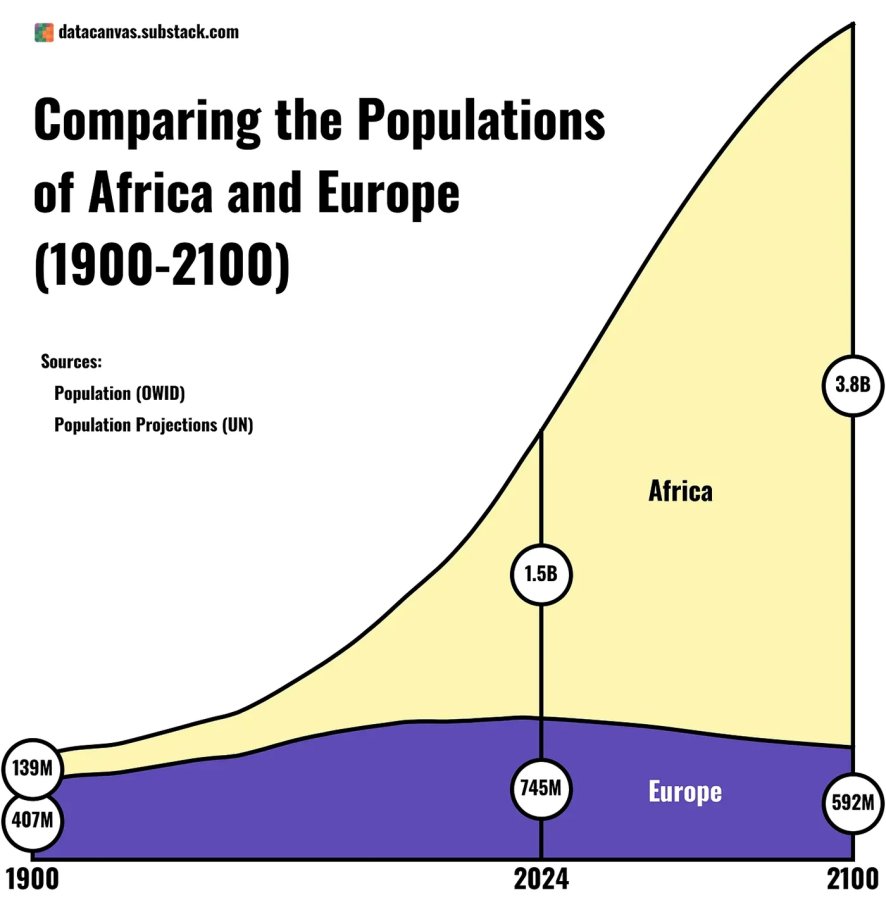
This chart, created by Oscar Leo of DataCanvas, compares the long-run population trends of Africa and Europe using UN Population Projections compiled by Our World in Data. It highlights one of the most dramatic demographic shifts of the past 100 years, and the even bigger changes expected ahead.
Below is a comparison of population data in Europe and Africa from 1950 to 2024, and projected out until 2100.
| Year | Africa Population (M) | Europe Population (M) |
|---|---|---|
| 1950 | 227.8 | 548.9 |
| 1960 | 283.9 | 605.8 |
| 1970 | 365.6 | 657.0 |
| 1980 | 483.1 | 694.3 |
| 1990 | 643.8 | 724.1 |
| 2000 | 830.6 | 728.2 |
| 2010 | 1,072.2 | 738.1 |
| 2020 | 1,380.8 | 749.5 |
| 2030 | 1,727.2 | 738.4 |
| 2040 | 2,095.7 | 722.1 |
| 2050 | 2,466.6 | 703.0 |
| 2060 | 2,821.5 | 676.2 |
| 2070 | 3,145.2 | 648.6 |
| 2080 | 3,424.7 | 626.4 |
| 2090 | 3,649.0 | 608.7 |
| 2100 | 3,813.9 | 592.3 |
In 1900, Europe had roughly 407 million people, nearly three times Africa’s 139 million.
By 2100, Africa is projected to reach 3.8 billion, while Europe declines to about 592 million.
From European Peak to African Surge
In the 19th and early 20th centuries, Europe was a dominant population center. Industrialization, urbanization, and improvements in medicine drove rapid growth, even as millions emigrated abroad.
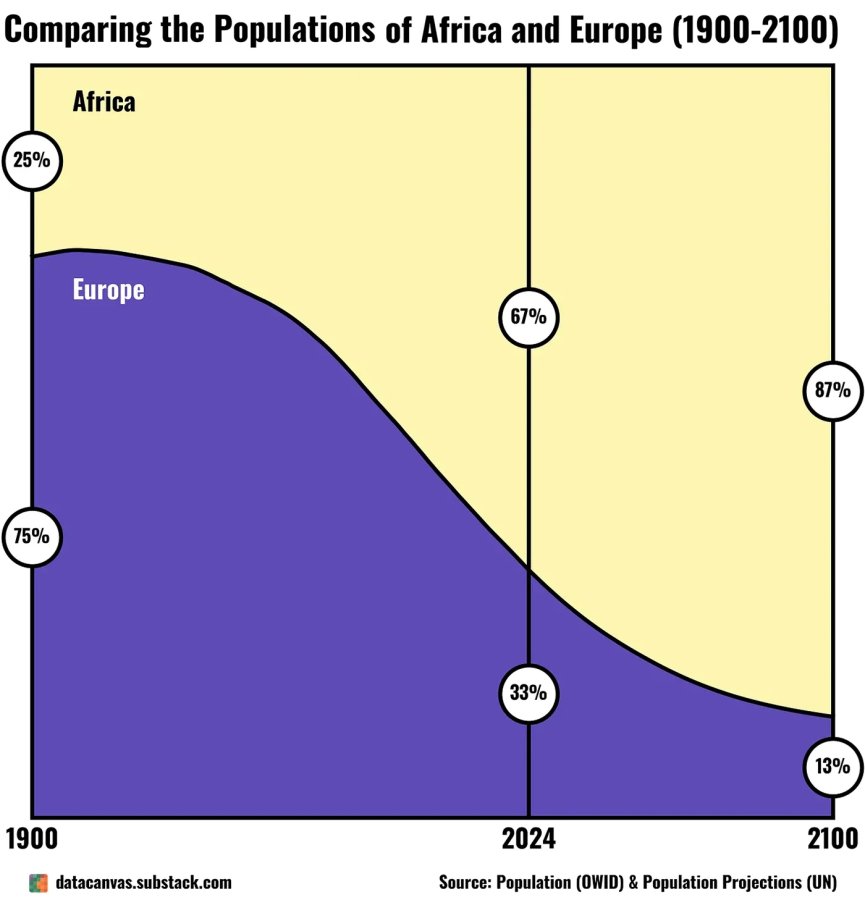
Europe’s population peaked in the late 20th and early 21st centuries. Since then, aging populations and persistently low fertility rates have slowed growth and, in many countries, triggered outright decline.
Africa’s recent demographic surge is more rapid and structurally transformative.
Africa as the Engine of Global Growth
Over the past few decades, Africa’s population has expanded rapidly due to high fertility rates and falling child mortality. Today, it is the fastest-growing continent.
According to UN projections, Africa will account for a large share of global population growth this century. By 2100, nearly one in three people on Earth could live on the continent.
This shift is closely tied to broader global trends, as shown in our analysis of the world’s top countries by population in 2100, where several African nations climb into the top ranks.
Why the Divergence?
The divergence between Europe and Africa reflects differences in:
- Fertility rates: Europe averages well below replacement levels, while many African countries remain above it.
- Median age: Europe is one of the world’s oldest regions; Africa is the youngest.
- Migration patterns: Immigration cushions Europe’s decline, but not enough to offset aging trends.
The result is a profound rebalancing of global demographics. Two centuries ago, Europe was a population heavyweight and Africa comparatively small. By the end of this century, Africa will be the clear demographic engine of the world.