
Driving Collective Accountability Through Leadership Behaviors
A company can have high-performing teams and still struggle to execute its strategy. When departments operate in silos, poor coordination and unclear accountability can hold back the entire organization, particularly during periods of major change.
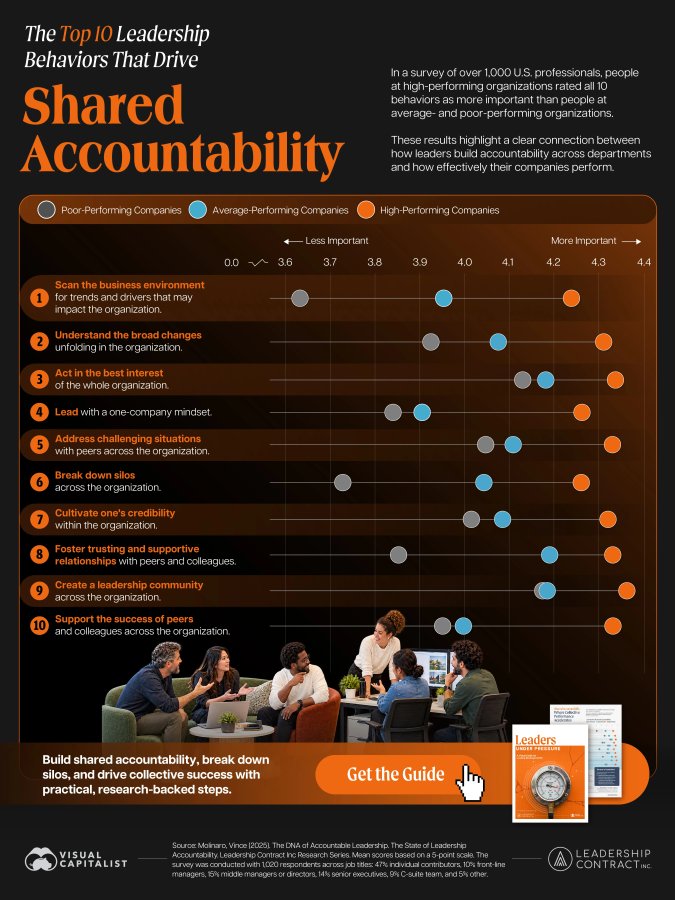
So what do leaders at high-performing organizations prioritize? This graphic examines 10 leadership behaviors linked to stronger collaboration and accountability across departments. It’s a preview of the executive guide from Leadership Contract Inc. and Visual Capitalist, Leaders Under Pressure: A Visual Guide for Leading Strategic Shifts.
The Importance of Behaviors That Build Shared Accountability
Respondents were asked to rate the importance of key behaviors in relation to the strongest, most accountable leaders in their company.
High-performing companies gave every behavior a score of more than 4.2 out of 5, assigning the highest importance to “create a leadership community across the organization.” In practice, this can mean regularly bringing leaders together across departments to align priorities, solve problems, and learn from one another.
| Behavior | Poor-Performing Company Rating | Average-Performing Company Rating | High-Performing Company Rating |
|---|---|---|---|
| Scan the business environment for trends and drivers that may impact the organization. | 3.629 | 3.954 | 4.237 |
| Understand the broad changes unfolding in the organization. | 3.919 | 4.081 | 4.309 |
| Act in the best interest of the whole organization. | 4.129 | 4.181 | 4.334 |
| Lead with a one-company mindset. | 3.839 | 3.906 | 4.269 |
| Address challenging situations with peers across the organization. | 4.048 | 4.109 | 4.326 |
| Break down silos across the organization. | 3.726 | 4.043 | 4.266 |
| Cultivate one's credibility within the organization. | 4.016 | 4.084 | 4.317 |
| Foster trusting and supportive relationships with peers and colleagues. | 3.855 | 4.188 | 4.329 |
| Create a leadership community across the organization. | 4.177 | 4.179 | 4.36 |
| Support the success of peers and colleagues across the organization. | 3.952 | 3.995 | 4.323 |
Source: Molinaro, Vince (2025). The DNA of Accountable Leadership. The State of Leadership Accountability. Leadership Contract Inc Research Series. Mean scores based on a 5-point scale. The survey was conducted with 1,020 respondents across job titles: 47% individual contributors, 10% front-line managers, 15% middle managers or directors, 14% senior executives, 9% C-suite team, and 5% other.
Enjoying this content? Dive into more insights in the Leaders Under Pressure guide:

After creating a leadership community, high-performing organizations rated “acting in the best interest of the whole organization” as the second-most important behavior. This means leaders look beyond their own role or team, even if it means deprioritizing their own initiatives to further the company’s strategy.
Leadership That Sets Companies Apart
The biggest gap in perceived importance between high- and poor-performing organizations was around scanning the business environment for trends and drivers that may impact the organization. Being aware of outside context can be critical for pivoting on outdated strategies or proactively acting on potential problems.
For example, a healthcare executive traveled in December 2019 through China, where her company regularly sourced materials. She heard people talking about a spreading virus and told her team to immediately place orders for raw materials. When the pandemic disrupted global supply chains, her company was able to maintain operations while competitors struggled.
It’s clear that leaders can follow specific, actionable steps to work together across departments and create shared accountability. When leaders create community, act with a one-company mindset, and understand the bigger picture, collective ownership follows.