All U.S. Critical Minerals, Ranked by Supply Disruption Risk
The U.S. relies heavily on imports for dozens of critical minerals used in everything from clean energy to defense. But what happens if those trade flows are disrupted?
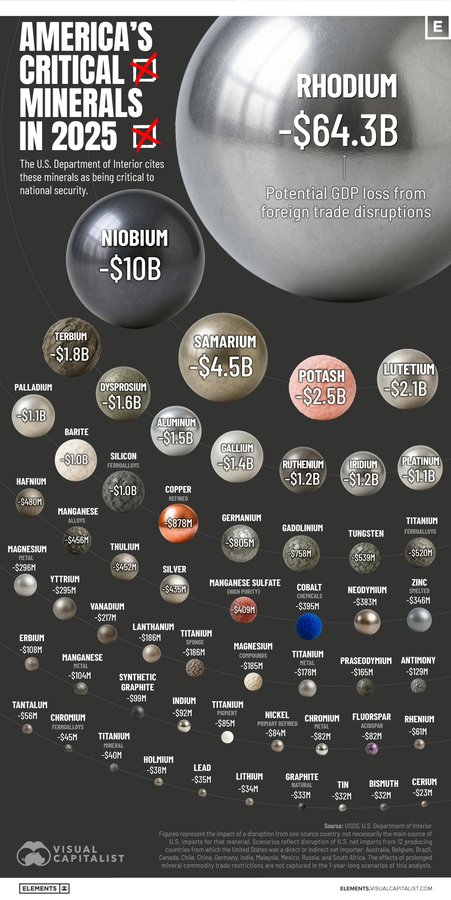
This visualization ranks the most economically important critical minerals to the U.S. in 2025, based on potential GDP loss from foreign trade disruptions. The data comes from the U.S. Geological Survey (USGS), and includes 84 critical commodities.
Rhodium Tops the Risk List
A disruption in the supply of rhodium—primarily from South Africa—could slash over $64 billion from U.S. GDP in a single year. That’s more than six times the estimated impact of the next highest-risk mineral, niobium, which is mostly sourced from Brazil. Both materials are key to automotive and aerospace industries.
| Mineral commodity | Potential GDP loss ($M) | Example usages |
|---|---|---|
| Rhodium | 64,340 | Automotive catalytic converters; chemical catalysts |
| Niobium | 10,441 | High-strength steels; superconductors; jet engines |
| Samarium | 4,498 | Permanent magnets; nuclear reactor control rods |
| Potash | 2,541 | Fertilizer; chemicals; water treatment |
| Lutetium | 2,059 | Petroleum cracking catalysts; lasers |
| Terbium | 1,809 | Green phosphors; high-performance magnets |
| Dysprosium | 1,624 | High-temperature magnets (EV motors, wind turbines |
| Aluminum | 1,537 | Transportation; packaging; construction |
| Gallium | 1,418 | Semiconductors; LEDs; solar cells |
| Ruthenium | 1,249 | Electronics coatings; chip interconnects; catalysts |
| Iridium | 1,163 | Spark plugs; crucibles; catalysts |
| Platinum | 1,144 | Catalytic converters; catalysts; jewelry |
| Palladium | 1,053 | Auto catalysts; electronics; hydrogen purification |
| Barite | 1,001 | Oil and gas drilling fluids; paint; medical imaging |
| Silicon ferroalloys | 1,000 | Steelmaking; cast iron alloying |
| Copper, refined | 878 | Wiring; plumbing; electronics |
| Germanium | 805 | Fiber optics; infrared optics; solar cells |
| Gadolinium | 758 | MRI contrast agents; neutron absorbers; phosphors |
| Tungsten | 539 | Cutting tools; drilling; aerospace alloys |
| Titanium ferroalloys | 520 | Steel additive; specialty alloys |
| Hafnium | 480 | Nuclear reactor rods; superalloys; semiconductors |
| Manganese alloys | 456 | Steel alloying; desulfurization |
| Thulium | 452 | Portable X-ray devices; lasers |
| Silver | 435 | Electronics; photovoltaics; jewelry |
| Manganese sulfate (high purity) | 409 | Battery precursor (NMC/NCA cathodes) |
| Cobalt chemicals | 395 | Battery precursors; catalysts; pigments |
| Neodymium | 383 | Permanent magnets; wind turbines; EV motors |
| Zinc, smelted | 346 | Galvanizing; alloys; rubber additives |
| Magnesium metal | 296 | Aerospace and automotive lightweighting |
| Yttrium | 295 | LEDs; phosphors; ceramics; superconductors |
| Vanadium | 217 | Steel strengthening; catalysts; redox-flow batteries |
| Lanthanum | 186 | Refinery catalysts; camera lenses; NiMH batteries |
| Titanium sponge | 186 | Titanium metal feedstock; aerospace alloys |
| Magnesium compounds | 185 | Refractories; desulfurization; fertilizers |
| Titanium metal | 178 | Aerospace structures; medical implants |
| Praseodymium | 165 | Magnets; pigments; aircraft alloys |
| Antimony | 129 | Flame retardants; lead-acid batteries; alloys |
| Erbium | 108 | Fiber amplifiers; glass colorant; lasers |
| Manganese metal | 104 | Aluminum alloys; steels; batteries |
| Synthetic graphite | 99 | Battery anodes; electrodes; lubricants |
| Indium | 92 | ITO coatings; solders; semiconductors |
| Titanium pigment | 85 | White pigment for paints, plastics, paper |
| Nickel, primary refined | 84 | Stainless steel; battery cathodes; alloys |
| Chromium metal | 82 | Superalloys; coatings; aerospace |
| Fluorspar, acidspar | 82 | Hydrofluoric acid; aluminum/steel flux; refrigerants |
| Rhenium | 61 | Superalloys for turbine blades; catalysts |
| Tantalum | 56 | Capacitors; superalloys; carbide tools |
| Chromium ferroalloys | 45 | Stainless/heat-resistant steels; superalloys |
| Titanium mineral concentrates | 40 | Feedstock for TiO₂ pigment and titanium metal |
| Holmium | 38 | Magnets; lasers; glass colorant |
| Lead | 35 | Lead-acid batteries; radiation shielding; ammunition |
| Lithium | 34 | Batteries; greases; glass/ceramics |
| Natural graphite | 33 | Battery anodes; refractories; lubricants |
| Tin | 32 | Solder; tinplate; chemicals |
| Bismuth | 32 | Pharmaceuticals; low-melt alloys; cosmetics |
| Cerium | 23 | Glass polishing; catalysts; additives |
Rare Earths Carry Broad Economic Exposure
Rare earth elements like samarium, terbium, and dysprosium rank high on the list. These are critical for magnets, motors, and high-tech applications like EVs and wind turbines.
China dominates the global supply of rare earths, accounting for over 69% of production. This dominance extends beyond mining, with China also processing nearly 90% of the world’s rare earth elements.
The USGS found that China contributes to the GDP risk of 46 of the 84 minerals studied.
Battery Metals and Beyond
Lithium, cobalt, and synthetic graphite—all crucial for battery production—appear lower in absolute dollar terms, but are still vital to long-term energy security. Magnesium, gallium, and germanium also raise red flags due to limited suppliers and essential applications in electronics, defense, and clean tech.