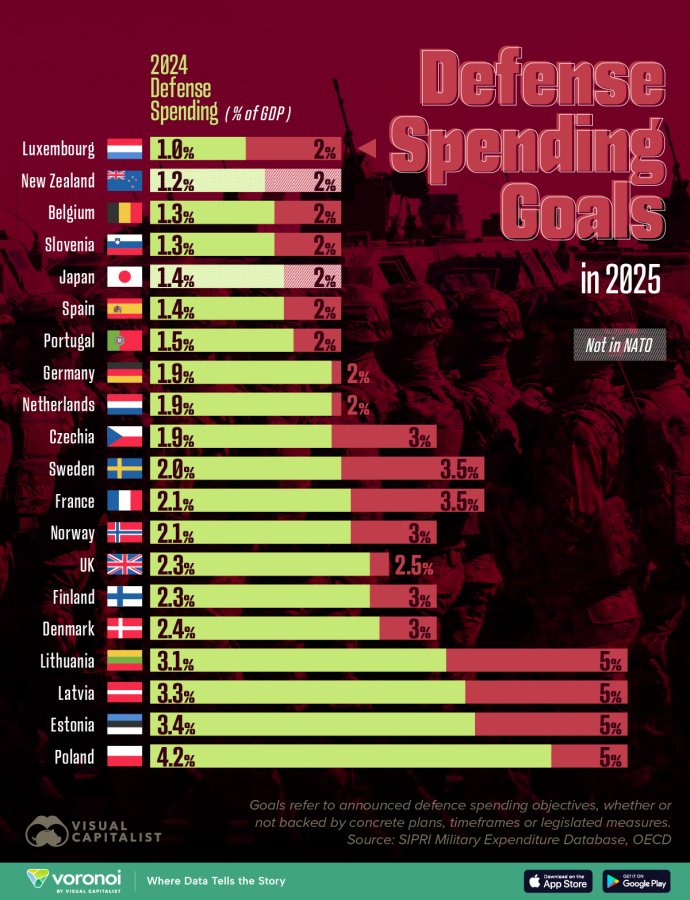
Defense Spending Goals in 2025
In an era of shifting security landscapes, governments are under pressure to justify defense budgets.
U.S. President Donald Trump has pressed NATO allies to invest 5% of their gross domestic product in defense. “Most countries are ready to ramp up security spending even more,” NATO Secretary-General Mark Rutte said recently.
This chart highlights how 20 countries stack up against self-declared spending goals for 2025.
Data & Discussion
The data for this visualization comes from OECD Economic Outlook, Volume 2025 Issue 1. It compares each country’s 2024 defense outlay as a share of GDP against its official spending target.
Eastern Europe Faces the Largest Shortfalls
The Baltic states rank highest in spending but also show the biggest gaps to their targets. Latvia trails by 1.74 percentage points (pp) and Lithuania by 1.88 pp. Both nations already exceed NATO’s 2% benchmark as a deterrence measure. Still, they aim for 5% of GDP. According to SIPRI, regional threats continue to push these targets upward.
| Country | 2024 Defense Spending (% of GDP) | Goal (% of GDP) |
|---|---|---|
| Luxembourg | 1.0 | 2 |
| New Zealand | 1.2 | 2 |
| Belgium | 1.3 | 2 |
| Slovenia | 1.3 | 2 |
| Japan | 1.4 | 2 |
| Spain | 1.4 | 2 |
| Portugal | 1.5 | 2 |
| Germany | 1.9 | 2 |
| Netherlands | 1.9 | 2 |
| Czechia | 1.9 | 3 |
| Sweden | 2.0 | 3.5 |
| France | 2.1 | 3.5 |
| Norway | 2.1 | 3 |
| United Kingdom | 2.3 | 2.5 |
| Finland | 2.3 | 3 |
| Denmark | 2.4 | 3 |
| Lithuania | 3.1 | 5 |
| Latvia | 3.3 | 5 |
| Estonia | 3.4 | 5 |
| Poland | 4.2 | 5 |
Western Europe Balances Budgets and Security
Several Western European countries, including Luxembourg, Belgium, and Spain, spend between 1.0% and 1.4% of GDP, below their 2% goals. Many of these governments prioritize social programs alongside defense commitments. As the World Bank reports, public spending trade-offs have kept military budgets constrained in these economies.
Major Powers Near Their Marks
The United Kingdom, France, and Germany lead among large economies, with spending at 2.3%, 2.1%, and 1.9% of GDP respectively. The UK targets 2.5%, while France and Germany aim for 3.5% and 2%.