Where Science and Math Graduates Make Up the Largest Share
As the global economy becomes more technology-driven, science and math graduates are playing an increasingly important role in innovation and growth. Countries with strong pipelines of science and mathematics talent may be favorably positioned to build the industries of the future.
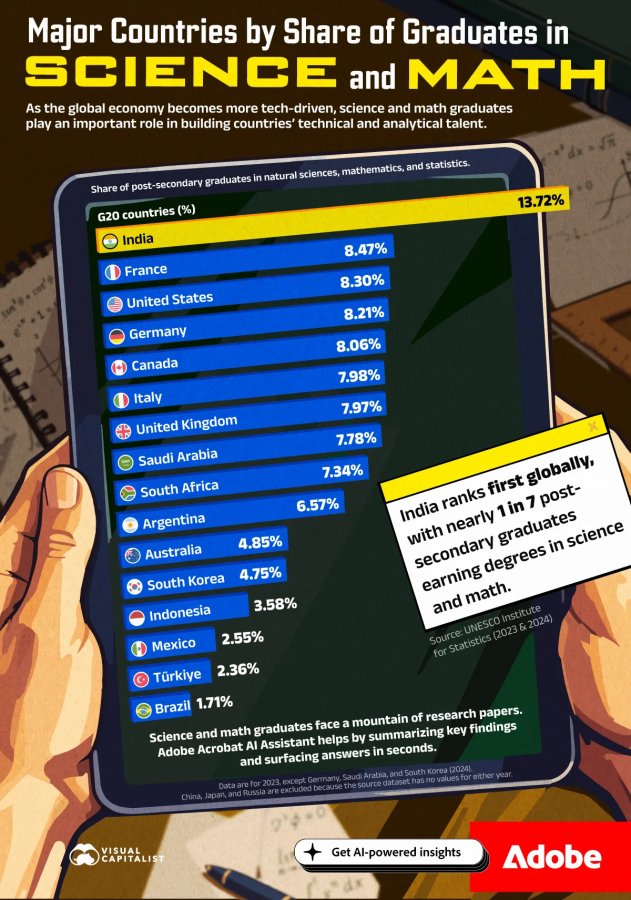
This graphic, created in partnership with Adobe, ranks countries by the share of tertiary graduates earning degrees in natural sciences, mathematics, and statistics. The data comes from UNESCO.
India Leads in Science and Math Graduates
India ranks first, with 13.7% of tertiary graduates earning degrees in natural sciences, mathematics, and statistics. That works out to nearly one in seven graduates.
The table below ranks the countries shown by the share of tertiary graduates earning degrees in natural sciences, mathematics, and statistics.
| G20 country | Share of graduates in science and math | Data year |
|---|---|---|
| India | 13.7% | 2023 |
| France | 8.5% | 2023 |
| United States (U.S.) | 8.3% | 2023 |
| Germany | 8.2% | 2024 |
| Canada | 8.1% | 2023 |
| Italy | 8.0% | 2023 |
| United Kingdom (UK) | 8.0% | 2023 |
| Saudi Arabia | 7.8% | 2024 |
| South Africa | 7.3% | 2023 |
| Argentina | 6.6% | 2023 |
| Australia | 4.9% | 2023 |
| South Korea | 4.8% | 2024 |
| Indonesia | 3.6% | 2023 |
| Mexico | 2.6% | 2023 |
| Türkiye | 2.4% | 2023 |
| Brazil | 1.7% | 2023 |
China, Japan, and Russia are excluded because the source dataset has no values for either year.
Belize ranks second at 11.6%, followed by Algeria at 11.0%. Madagascar ranks fourth at 9.9%, while Uzbekistan and Nepal both stand at 9.7%.
India’s lead highlights the strength of its science and math graduate pipeline. These graduates bring technical skills that can support research, innovation, and a growing range of industries.
How Graduates Compare Across the Most Major Economies
Several of the world’s largest advanced economies appear further down the ranking.
France has the highest share among the G7 countries shown, at 8.5%. The U.S. follows at 8.3%, while Canada stands at 8.1%. Italy and the United Kingdom each sit at 8.0%, just ahead of Germany at 7.9%.
Overall, the ranking shows how widely the share of science and math graduates can vary between countries, regardless of the size or development of their economies.
Supporting India’s Growing Tech Workforce
Science and math graduates often need to make sense of lengthy research papers and complex findings. AI PDF tools can help them explore documents and find relevant information, while an AI summary generator provides an overview to guide deeper reading. By spending less time navigating documents, graduates can focus more on evaluating evidence and applying what they learn to research and professional practice.