Visualized: The Human and Economic Cost of the Syrian Civil War
What began in March 2011 as pro-democracy protests against President Bashar al-Assad’s government spiraled into one of the most brutal conflicts of the 21st century, drawing in regional and global powers and resulting in immense human suffering. Over more than a decade of war, hundreds of thousands of people lost their lives, and millions were forced from their homes.
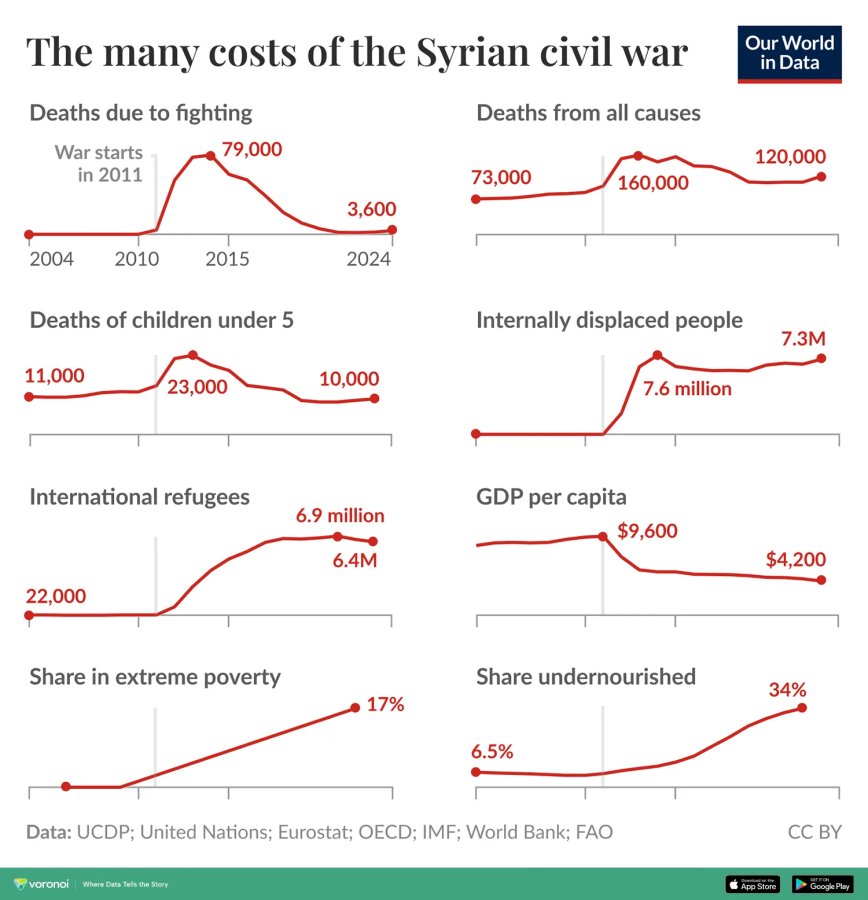
These charts from Our World in Data and sourced from the UN, Eurostat, the IMF, World Bank and others show the many costs of conflict — from fatalities to economic collapse and rising poverty.
Here’s a detailed look at the data behind the war’s impacts:
| Category (Syria) | Initial Data (2004) | Peak Data Point | Most Recent Data |
|---|---|---|---|
| Deaths due to fighting | ~0 | 79,000 | 3,600 |
| Deaths from all causes | 73,000 | 160,000 | 120,000 |
| Deaths of children under 5 | 11,000 | 23,000 | 10,000 |
| Internally displaced people | ~0 | 7.6 million | 7.3 million |
| International refugees | 22,000 | 6.9 million | 6.4 million |
| GDP per capita | $9,500 | $9,600 | $4,200 |
| Share in extreme poverty | 0.50% | 17% | 17% |
| Share undernourished | 6.50% | 34% | 34% |
The data illustrate several harsh realities: annual deaths from fighting spiked after 2011 with devastating loss of life, including among children, while total deaths from all causes rose. Millions of Syrians became internally displaced or refugees, GDP per capita plunged, and extreme poverty and undernourishment grew sharply.
Understanding the War’s Origins
The conflict began during the Arab Spring when peaceful protests were met with force by government security services. What followed was a fragmented civil war involving government forces, opposition groups, Kurdish militias, extremist factions, and international actors; including Russia, Iran, the U.S., Turkey, and others.
At its peak, organized violence devastated cities like Aleppo, Homs and Raqqa, and fracturing Syrian society. Hundreds of thousands were killed across combatants and civilians, and millions more were displaced internally and abroad, which remade the country’s demographics and burdened neighboring states.
Beyond the Battlefield: Economic and Social Impacts
The war’s impacts extend far beyond immediate conflict deaths. GDP per capita more than halved as economic activity collapsed amid destruction of infrastructure and displacement of workers. Extreme poverty (once rare in Syria) surged, while undernourishment became widespread.
This aligns with broader findings that violence imposes costs on societies far beyond direct combat, from lost productivity to health crises and long-term poverty.
What Happens Now?
Though large-scale warfare has diminished, Syria faces a fragile transition. Recent agreements between the central government and Kurdish forces aim to stabilize parts of the country, but humanitarian needs remain acute. Millions still depend on aid, and access to essential services is uneven.
Political fragmentation, economic collapse, and reconstruction needs—estimated in the hundreds of billions—mean recovery will be lengthy and uncertain, even as some areas see renewed governance and investment.