Where Americans Are Paying Off Their Mortgages
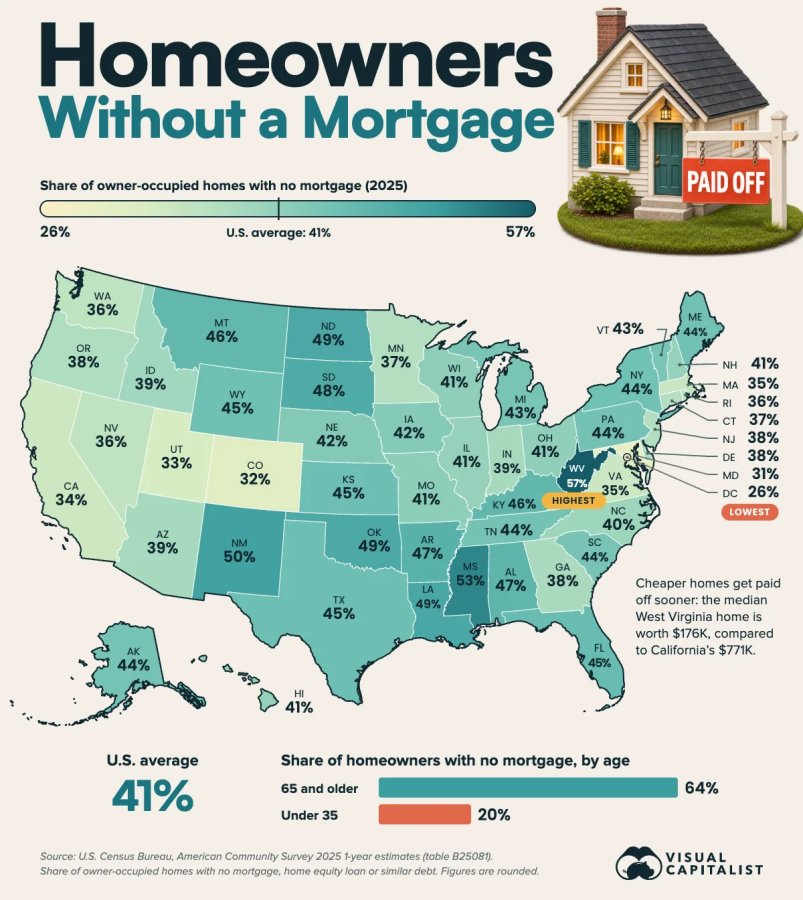
Roughly two in five owner-occupied homes in the U.S. are owned free and clear. In some states, more than half of homeowners have no mortgage at all.
This map shows the share of owner-occupied homes without a mortgage in all 50 states and Washington, D.C., using the U.S. Census Bureau’s 2025 American Community Survey. Mortgage-free homes have no mortgage, home equity loan, or similar debt secured by the property.
West Virginia Has the Highest Share of Paid-Off Homes
West Virginia leads with 56.6% of owner-occupied homes mortgage-free, 3.9 percentage points ahead of Mississippi at 52.7%. They are the only two states where more than half of owner-occupied homes have no mortgage.
Lower home prices may help explain part of the difference. The median owner-occupied home in West Virginia is worth about $176,000, less than a quarter of California’s $771,000. In California, just 34.4% of owner-occupied homes are mortgage-free.
Here are all 50 states and Washington, D.C., ranked by the share of owner-occupied homes without a mortgage in 2025:
| Rank | State or District | Mortgage-Free Owner-Occupied Homes, 2025 (%) |
|---|---|---|
| 1 | West Virginia | 56.6 |
| 2 | Mississippi | 52.7 |
| 3 | New Mexico | 50.0 |
| 4 | Louisiana | 49.1 |
| 5 | North Dakota | 48.9 |
| 6 | Oklahoma | 48.6 |
| 7 | South Dakota | 48.4 |
| 8 | Arkansas | 47.3 |
| 9 | Alabama | 46.7 |
| 10 | Kentucky | 46.2 |
| 11 | Montana | 46.1 |
| 12 | Florida | 45.3 |
| 13 | Texas | 44.7 |
| 14 | Kansas | 44.7 |
| 15 | Wyoming | 44.5 |
| 16 | New York | 44.4 |
| 17 | Maine | 44.2 |
| 18 | Tennessee | 44.1 |
| 19 | Pennsylvania | 44.0 |
| 20 | Alaska | 43.8 |
| 21 | South Carolina | 43.8 |
| 22 | Michigan | 43.4 |
| 23 | Vermont | 43.4 |
| 24 | Nebraska | 42.4 |
| 25 | Iowa | 42.2 |
| 26 | Missouri | 41.4 |
| 27 | Wisconsin | 41.3 |
| 28 | Ohio | 41.3 |
| 29 | Hawaii | 40.6 |
| 30 | Illinois | 40.5 |
| 31 | New Hampshire | 40.5 |
| 32 | North Carolina | 39.8 |
| 33 | Idaho | 39.5 |
| 34 | Indiana | 38.9 |
| 35 | Arizona | 38.7 |
| 36 | Georgia | 38.5 |
| 37 | Delaware | 38.2 |
| 38 | Oregon | 37.8 |
| 39 | New Jersey | 37.5 |
| 40 | Minnesota | 37.4 |
| 41 | Connecticut | 37.1 |
| 42 | Washington | 36.1 |
| 43 | Rhode Island | 35.9 |
| 44 | Nevada | 35.9 |
| 45 | Massachusetts | 35.2 |
| 46 | Virginia | 34.8 |
| 47 | California | 34.4 |
| 48 | Utah | 33.2 |
| 49 | Colorado | 31.6 |
| 50 | Maryland | 30.6 |
| 51 | District of Columbia | 26.5 |
| -- | U.S. Average | 41.0 |
Seven of the top 10 states are in the South. The Census Bureau also found that rural counties were more likely than urban counties to have high shares of mortgage-free homes, based on its 2024 five-year estimates.
Maryland has the lowest share among states, at 30.6%, while Washington, D.C., is lower still at 26.5%. Both have relatively expensive housing: typical home values reached about $428,000 in Maryland and $570,000 in D.C. in August 2026, compared with $369,000 nationally.
Higher home prices generally mean larger loans for buyers making the same percentage down payment, potentially making it harder to pay off a mortgage.
Older Homeowners Are Far More Likely to Be Mortgage-Free
Nationally, about 64% of homeowners age 65 and older own their homes free and clear, compared with 20% of homeowners under 35.
Older homeowners have had decades to pay down their loans. With a typical fixed-rate mortgage, early payments go largely toward interest, while later payments increasingly reduce the principal. This gives long-established owners an advantage over recent buyers.
Owning a home outright can also make retirement more affordable by eliminating monthly mortgage payments. The Federal Reserve finds that even among lower-income adults, older people are much more likely to own their homes outright.
However, mortgage-free doesn’t mean housing-cost-free. In 2025, median monthly owner costs were $703 for homes without a mortgage, compared with $2,163 for those with one. Even homeowners who have paid off their loans must still cover property taxes, insurance, utilities, and other expenses.
Still, eliminating a monthly mortgage payment can make a substantial difference to household finances, particularly for retirees living on fixed incomes.