Will AI Replace Jobs? Survey Results from 21 Countries
Will AI replace your job within the next decade?
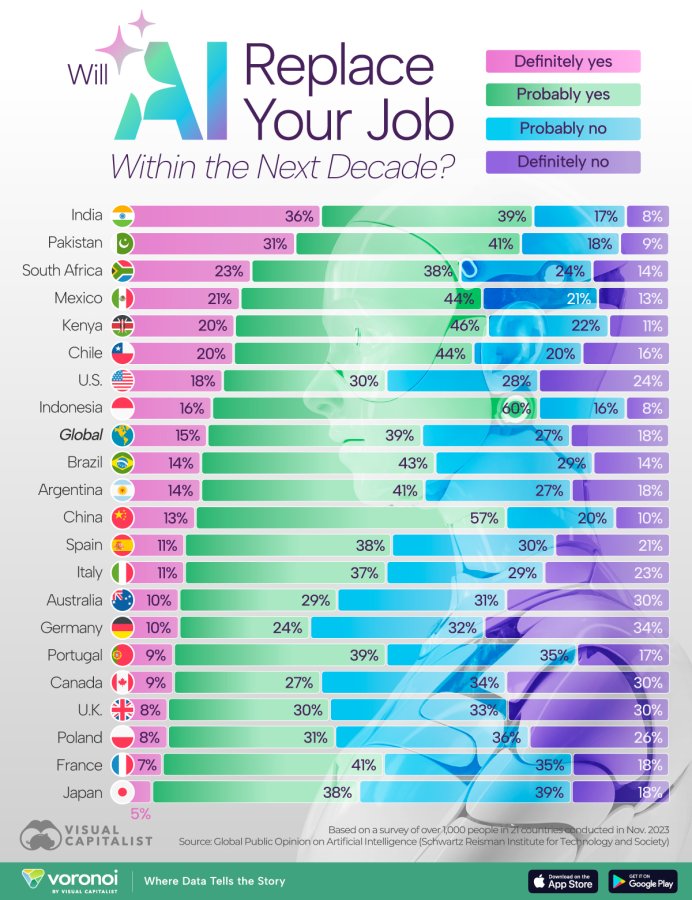
As artificial intelligence becomes more prevalent around the world, regional differences in how workers perceive the risk of automation are emerging.
While some countries show more confidence in job security, others anticipate widespread disruption from AI. This infographic compares levels of certainty, from “definitely yes” to “definitely no.”
Data & Discussion
The data for this visualization comes from Global Public Opinion on Artificial Intelligence (GPO-AI). It captures how people from 21 different countries (over 1,000 people each) perceive the likelihood that their job will be replaced by a computer or machine within the next 10 years.
| Country | Definitely yes |
Probably yes |
Probably no |
Definitely no |
|---|---|---|---|---|
| India | 36 | 39 | 17 | 8 |
| Pakistan | 31 | 41 | 18 | 9 |
| South Africa | 23 | 38 | 24 | 14 |
| Mexico | 21 | 44 | 21 | 13 |
| Kenya | 20 | 46 | 22 | 11 |
| Chile | 20 | 44 | 20 | 16 |
| U.S. | 18 | 30 | 28 | 24 |
| Indonesia | 16 | 60 | 16 | 8 |
| Global | 15 | 39 | 27 | 18 |
| Brazil | 14 | 43 | 29 | 14 |
| Argentina | 14 | 41 | 27 | 18 |
| China | 13 | 57 | 20 | 10 |
| Spain | 11 | 38 | 30 | 21 |
| Italy | 11 | 37 | 29 | 23 |
| Australia | 10 | 29 | 31 | 30 |
| Germany | 10 | 24 | 32 | 34 |
| Portugal | 9 | 39 | 35 | 17 |
| Canada | 9 | 27 | 34 | 30 |
| U.K. | 8 | 30 | 33 | 30 |
| Poland | 8 | 31 | 36 | 26 |
| France | 7 | 41 | 35 | 18 |
| Japan | 5 | 38 | 39 | 18 |
High Belief in Emerging Economies
India, Pakistan, and Indonesia stand out with the highest combined “yes” responses. In India, 75% of respondents believed their jobs would probably or definitely be replaced. Pakistan followed closely at 72%, while Indonesia saw 76% agreement.
These numbers suggest that in rapidly growing economies, where technology adoption is accelerating, workers are more alert to the risks of automation. Emerging economies may also have a higher share of jobs that involve routine or low-skilled labor, making them more susceptible to automation.
In a recent study titled Skill-Based Labor Market Polarization in the Age of AI: A Comparative Analysis of India and the United States, it was found that India’s labor market reveals a “double vulnerability”, meaning employment is concentrated in low-skill roles that also have high automation risk.
Mixed Expectations in Developed Nations
By contrast, countries such as Germany, Japan, and Canada show more skepticism. In Germany, only 34% thought replacement was likely, while 66% leaned toward “no.” Japan showed the lowest certainty, with just 5% saying “definitely yes.”
These responses may reflect stronger job protections, slower automation uptake, or greater trust in existing labor systems. Other research has suggested that jobs requiring human-to-human interaction are the safest from AI automation.