Which Countries Are the Biggest Threats to World Peace?
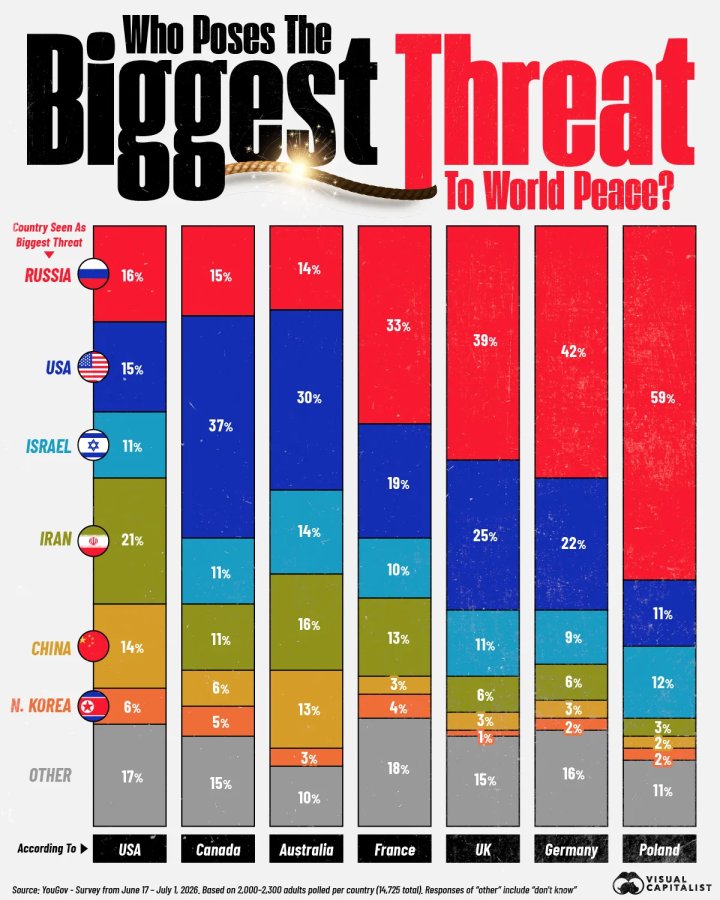
Which Countries Are the Biggest Threats to World Peace?
Which Countries Are the Biggest Threats to World Peace?
Ranked: U.S. States With the Widest Wage Gaps
This visualization ranks all 50 states by the dollar difference between the wage threshold for the top 10% of earners and the median wage. It shows where top wages pull furthest away from typical earnings across the country.
The data for this visualization comes from the U.S. Bureau of Labor Statistics Occupational Employment and Wage Statistics (OEWS) for May 2025.
California Leads the Wage Gap Rankings
California records the widest earnings gap in the country.
Ranked: World Currencies vs. the U.S. Dollar in 2026
Currency markets have produced some striking winners and losers over the past year, with gains and declines approaching 20% against the U.S. dollar.
This graphic ranks the one-year performance of 36 major currencies through June 30, 2026, based on data from Deutsche Bank. The results highlight sharp regional contrasts, particularly across Latin America and Asia.
The Colombian Peso Has Appreciated the Most
The Color of IKEA Sofas Over Time (1960–2021)
IKEA’s catalogs offer a remarkable visual history of changing interior tastes. Created by The European Correspondent using data manually collected from IKEA Catalogues, this visualization tracks the most prominent sofa colors featured each year between 1960 and 2021.
First published in 1951, the IKEA catalog went on to become one of the world’s most widely distributed publications. Its decades-long archive provides an unusually rich record of how mainstream furniture styles changed across generations.
Ranked: Where Coal Consumption Rose the Most in 2025
Just five countries—China, India, the U.S., Indonesia, and Japan—accounted for 80% of the world’s growing coal consumption in 2025. The biggest driver of rising demand was the United States, with a year-over-year increase of 10%.
This graphic uses data from the Energy Institute’s Statistical Review of World Energy 2026. It ranks regions by change in coal consumption between 2024 to 2025 in exajoules (EJ).
For reference, a single exajoule of energy can power approximately 25 million U.S. homes for a year.