Ranked: The Hourly Wage of Retail CEOs
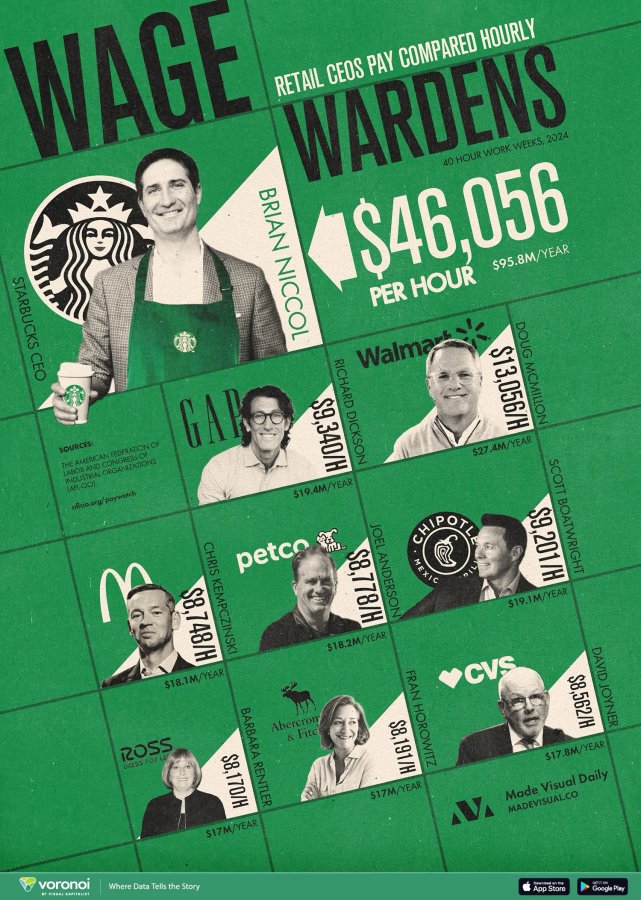
How much does a retail CEO make per hour? A recent AFL-CIO analysis breaks down executive pay by the hour, assuming a standard 40-hour work week—and the numbers are staggering. The data, visualized by Made Visual Daily, exposes just how wide the wage gap is in the retail sector.
Here’s how much top CEOs in the retail sector earn:
| Ticker | Company | CEO | Pay (2024) | Hourly |
|---|---|---|---|---|
| SBUX | Starbucks | Brian Niccol | $95,801,676 | $46,058 |
| WMT | Walmart | Doug McMillon | $27,408,854 | $13,177 |
| GAP | Gap | Richard Dickson | $19,426,846 | $9,340 |
| CMG | Chipotle Mexican Grill | Scott Boatwright | $19,137,518 | $9,201 |
| WOOF | Petco | Joel Anderson | $18,258,291 | $8,778 |
| MCD | McDonald's | Christopher Kempczinski | $18,195,263 | $8,748 |
| CVS | CVS | David Joyner | $17,808,792 | $8,562 |
| ANF | Abercrombie & Fitch | Fran Horowitz | $17,036,310 | $8,191 |
| ROST | Ross | Barbara Rentler | $16,994,251 | $8,170 |
At a glance, it’s clear that Starbucks CEO Brian Niccol is the outlier—earning a jaw-dropping $46,058 per hour. That’s about 3.5x the hourly rate of the next highest-paid CEO on the list.
CEO Pay vs. Worker Pay
While some level of pay disparity between executives and frontline workers is expected, recent figures are fueling conversations about extreme inequality. According to The Hill, the average S&P 500 CEO made 272 times more than their median employee in 2022. In retail, where many employees earn near-minimum wage, the disparity can be even greater.
Take Doug McMillon of Walmart, who earns $13,177 per hour, or $27.4 million a year. Compare that to the average Walmart associate earning around $15 per hour. That’s a pay gap exceeding 875x.
How Executive Compensation Works
Much of a CEO’s compensation doesn’t come from base salary—it typically includes stock options, performance bonuses, and other incentives that balloon total pay. Critics argue these packages incentivize short-term gains over long-term stability.
Meanwhile, hourly wages for the average American worker have struggled to keep pace with inflation, further amplifying scrutiny over ballooning executive pay.
Corporate Governance and Pay Reform
Pressure is mounting from shareholders and labor groups to better align CEO compensation with company performance and worker welfare. Some companies are experimenting with “stakeholder capitalism,” tying executive bonuses to ESG metrics or employee satisfaction. But such efforts remain the exception rather than the norm.
In an era of heightened awareness around income inequality, data visualizations like this one serve as potent reminders of the systemic challenges facing the American labor economy.