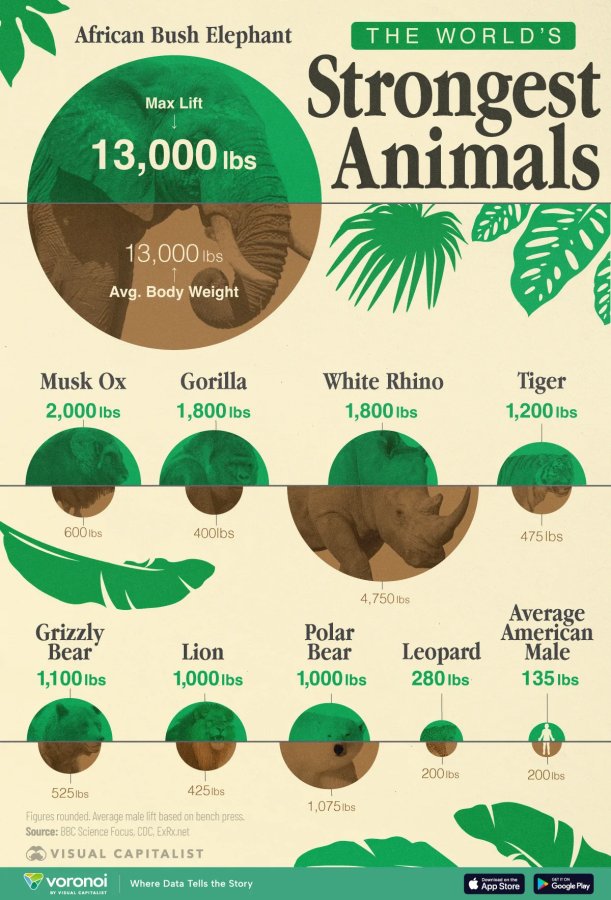
Visualized: The World’s Strongest Animals
The animal kingdom showcases some extraordinary examples of strength, with species evolving specialized muscles, body mechanics, and leverage to survive.
In this graphic, we ranked the world’s strongest animals based on the maximum weight they’re capable of lifting.
Data & Discussion
The data for this visualization comes from BBC Science Focus. The max lift (measured by bench press) of an average American male was included for context.
| Animal | Max Lift (lbs) | Typical Body Weight (lbs) |
|---|---|---|
| Avg. American male | 135 | 200 |
| Leopard | 280 | 110 |
| Polar bear | 1,000 | 1,075 |
| Lion | 1,000 | 425 |
| Grizzly bear | 1,100 | 525 |
| Tiger | 1,200 | 475 |
| Musk ox | 2,000 | 600 |
| White rhino | 1,800 | 4,750 |
| Gorilla | 1,800 | 400 |
| African bush elephant | 13,000 | 13,000 |
Elephants: Nature’s Powerhouse
The African bush elephant stands out in terms of absolute strength. Capable of lifting 13,000 pounds, the equivalent of a small school bus, it’s the most powerful land animal alive.
Elephant trunks can contain up to 40,000 muscles, which allows for both delicate tasks like picking up a single blade of grass and massive feats of strength like uprooting trees.
Elephants are also one of the world’s longest-living mammals, though their lifespans are shorter than humans.
Big Cats and Gorillas
Among carnivores, the tiger ranks as the most muscular predator. It has the ability to lift more than twice its body weight, and uses explosive movements for hunting prey.
Gorillas, despite being primarily herbivores, rival big cats in raw power. Their upper-body muscles allow them to lift over 1,800 pounds.
Compared to humans, gorillas have extremely dense muscle fibers as well as longer arms and thicker bones.
The Strongest in Relative Terms
While it can’t lift 1,000 pounds, the dung beetle is the world’s strongest creature when measured in relative terms.
Found in almost every region of the world, this feces-eating bug can push up to 40 pounds, equal to over 1,100 times its own body weight.